
Missouri Projected and Actual Release
Missouri's public MODOC file does not document a consumer field literally named “projected release date” or “tentative release date.” Its official names are Sentence Maximum Release Date and Sentence-I Minimum Release Date. The maximum is the sentence expiration day. The minimum is a calculated minimum date on the active sentence. Neither label, standing alone, proves the day someone will walk out.
Scheduled versus actual release: A sentence date is a calculation snapshot. The actual exit depends on current sentence data, law, Board action, holds, and institutional processing.
A pretrial county detainee usually has no sentence-based release date. Bond, a court order, dismissal, transfer, or later sentencing may determine the next custody event. A county sentence is computed by the local jail and court, while a state sentence belongs with MODOC. Federal and immigration dates remain in their own systems.
Find a Missouri Prison Release Date
Start with the active MODOC offender search when the person remains under Missouri Department of Corrections supervision. A DOC master number is the strongest key. Name searches include aliases, but they still require a careful match with the cause number, county, offense, and sentence details. Record the page's data-current timestamp.
- Confirm that the person is in a MODOC prison or remains active under MODOC supervision.
- Search with the DOC number. If it is unknown, use first and last name and test a documented alias.
- Match identity and court facts before copying any date.
- Read the assignment as institution or field, then preserve every sentence-date label exactly.
- Compare the court cause number and sentence with Case.net. Ask the institutional parole office about the current individual calculation.
The official MODOC search screen explains active scope and offers the initial name fields.
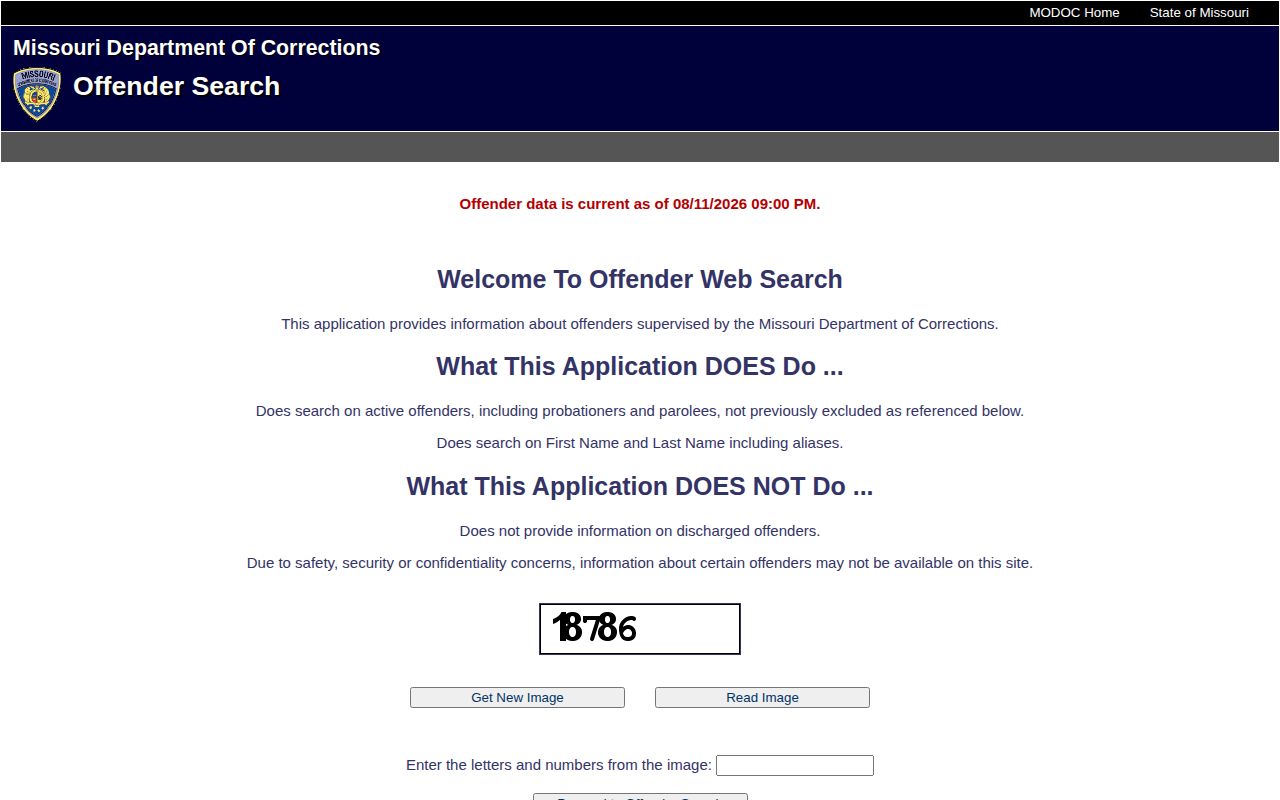
A live result is useful for current status, but the search excludes people after final discharge.
Note: A field assignment means active community supervision; it does not mean the whole sentence has ended through final discharge.
Missouri Historical Sentence Date Fields
When the active result is gone, use MODOC's nightly Sunshine Law offender file. It covers current and former supervision, with records extending as far back as 1974. The file is charge-level, so one person can occupy several rows. Group by DOC ID. Read every sentence, completed flag, and concurrent-or-consecutive indicator before trying to understand the date picture.
| Value or field | Meaning in the MODOC layout |
|---|---|
| Sentence Maximum Release Date | The documented sentence expiration date. |
| Sentence-I Minimum Release Date | The calculated minimum release date on the active sentence. |
| 99999999 | Life sentence sentinel value, not a calendar date. |
| 88888888 | Indeterminate or interstate sentinel value. |
| 66666666 | Court-ordered assessment or investigation sentinel value. |
| Sentence completed Y | That row is complete; other sentence rows may remain active. |
The MODOC Sunshine database page provides both the file and its layout.
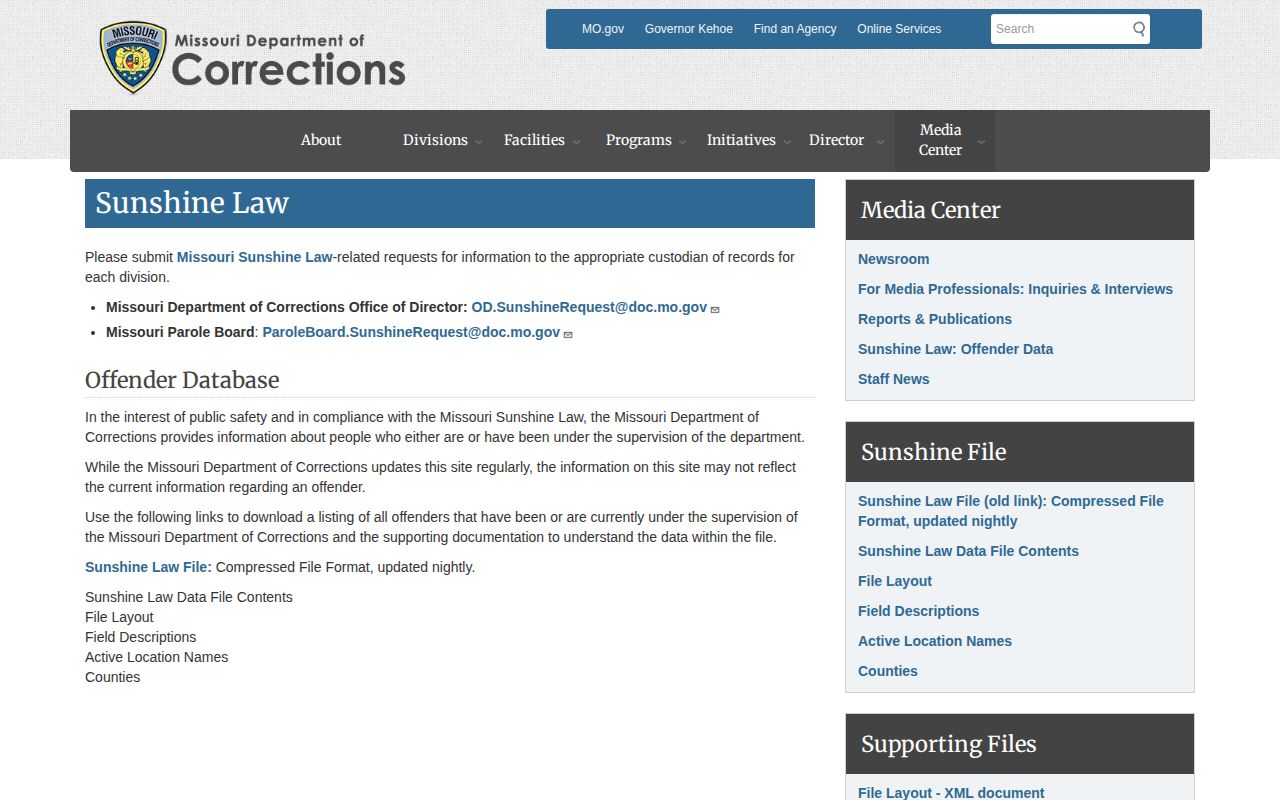
The layout is essential because its sentinel values must never be rendered as ordinary dates.
Three Missouri Release Date Layers
Missouri's distinctive release-date structure has three legal layers. First, section 558.011 generally divides covered term-of-years felony sentences into an incarceration term and a conditional-release term. For terms of nine years or less, the conditional portion is generally one-third. For terms over nine through fifteen years it is three years, and for terms over fifteen years it is five years, subject to statutory exclusions.
Second, section 558.019 imposes a minimum on a dangerous-felony conviction. The person must serve 85 percent before parole, conditional release, or another early release, or reach age 70 after serving at least 40 percent, as the statute provides. The offense definition comes from section 556.061. This rule can block an earlier route that might apply to another offense.
Third, section 558.041 permits eligible prisoners to receive discretionary additional credit after an institutional superintendent's recommendation under director policy. MODOC's Blue Book calls the resulting route Administrative Parole or Good Time Credit Release. The Board still reviews the case and may decline the release.
| Layer | What it controls | What it does not prove |
|---|---|---|
| Conditional release | The statutory custody and supervision portions of many term sentences | An unconditional or unchangeable exit day |
| Dangerous-felony minimum | The minimum share that must be served for a covered conviction | Automatic release when the minimum is reached |
| Good-time administrative parole | A discretionary credit and Board route for eligible cases | A guaranteed sentence subtraction |
Note: Missouri requires date reconciliation, not an unsourced online calculator that turns a sentence length into a promised exit.
Reconcile a Missouri Release Calculation
Begin with the judgment and each sentence row. Note the offense date, offense classification, sentence date, length, and whether terms run at the same time or one after another. Then separate the maximum expiration from the minimum eligibility point. A minimum date can mark when one route becomes possible. It is not the same as a Board decision or a scheduled physical exit.
Next, identify which rule applies to each conviction. The ordinary conditional-release split may govern one term, while a dangerous-felony minimum limits another. A good-time recommendation adds a discretionary layer rather than replacing the base sentence. Custody credit under section 558.031 is its own calculation. When there are several rows, the most favorable-looking date on one row cannot be used without checking the rest.
Finally, compare the calculation with current MODOC and Board facts. Ask whether the person has completed required programs, whether discipline changed the credit or conditional-release route, whether a Board decision is entered, and whether another hold awaits. A reliable answer states the date's exact label, its source and update time, and the unresolved events that could still affect release.
Do not merge a parole date with a maximum date. Parole is a discretionary Board release under conditions. Conditional release is a statutory part of many sentences. Administrative parole can follow a good-time recommendation. Maximum expiration is yet another point. If a record presents several of them, list each one on its own line and state what decision or rule supports it.
- Minimum date
- A calculated threshold on the active sentence, not a release guarantee.
- Maximum date
- The documented sentence-expiration date field.
- Eligibility
- The point when a person may be considered under a stated rule.
- Scheduled release
- A future custody event set after the required decision and calculation.
- Actual release
- The completed physical departure from that custody system.
Missouri Good Time Is Discretionary
Good time can reward orderly conduct and use of programs, but it is not automatic. The institutional superintendent recommends eligible credit. The director's policy governs it, and misconduct can cause loss. The credit applies to the sentence being served. Exclusions also matter.
The Parole Board then considers more than arithmetic. The official Blue Book lists offense conduct, victim impact, criminal history, institutional adjustment, completed or needed programs, the release plan, and community information. Administrative parole therefore remains a decision rather than a date produced by a calculator.
The Missouri Parole Board page supplies the rules and sentence-guideline materials used to frame that process.
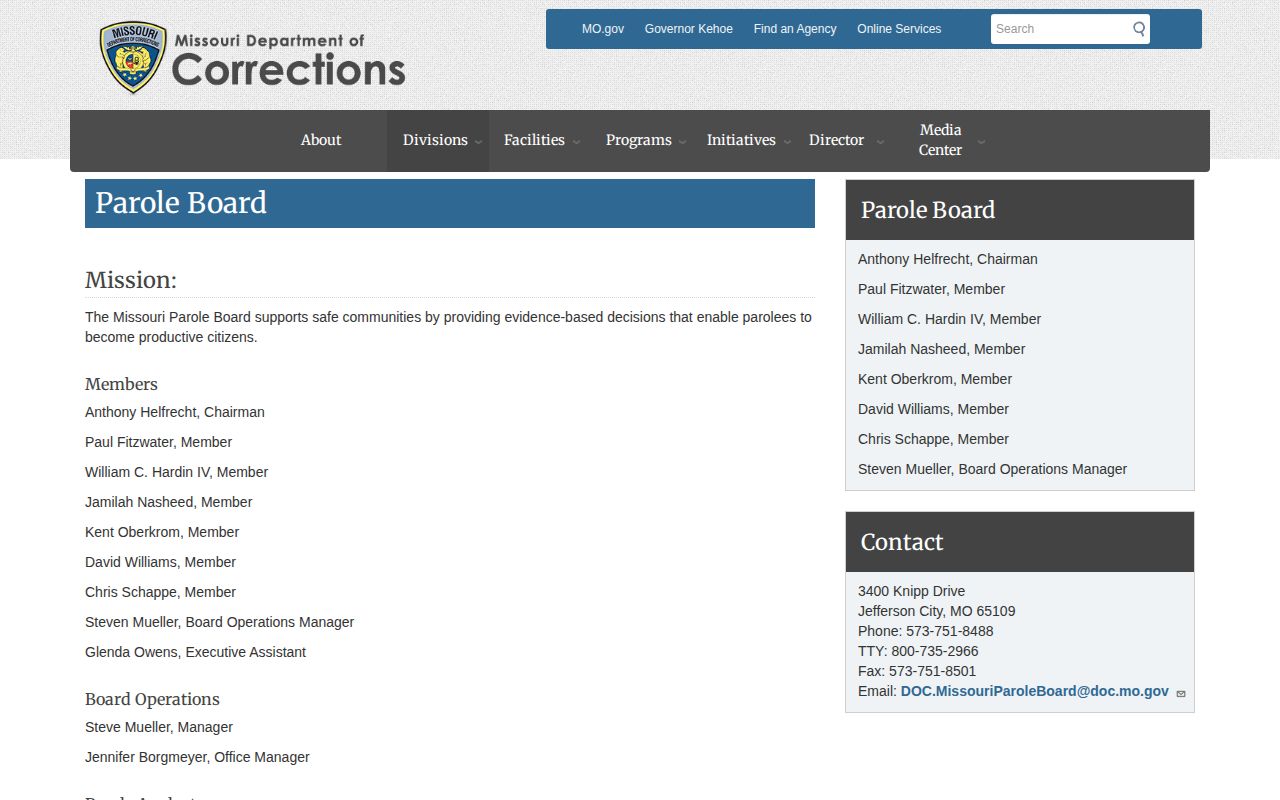
The guidelines aid review, yet the Board reserves discretion where Missouri law permits.
Why Missouri Release Dates Change
Even a correctly copied minimum or maximum date can change in meaning or practical effect. A sentence correction may alter the source data. Consecutive terms must be read together. Custody credit under section 558.031 is different from prison good time, and revocation can change the credit analysis.
| Factor | Possible effect | Best confirmation |
|---|---|---|
| Consecutive sentences | A later term changes the combined custody timeline. | MODOC sentence records and the court judgments |
| Custody credit | Qualifying prior custody may be credited under governing law. | Current MODOC computation and court record |
| Institutional misconduct | Good time may be lost or conditional release may be extended. | Institutional caseworker or parole office |
| Board action | A hearing may lead to a later hearing or a future release date. | Board decision or records custodian |
| Detainer or hold | Departure from MODOC may lead to another custody system. | Each agency that lodged or receives the hold |
| Final discharge | The active search record disappears after supervision ends. | Historical file or discharge record |
A release decision also takes time to enter and communicate. The MODOC decision-timing page says a Board decision ordinarily takes 8 to 12 weeks after a hearing.
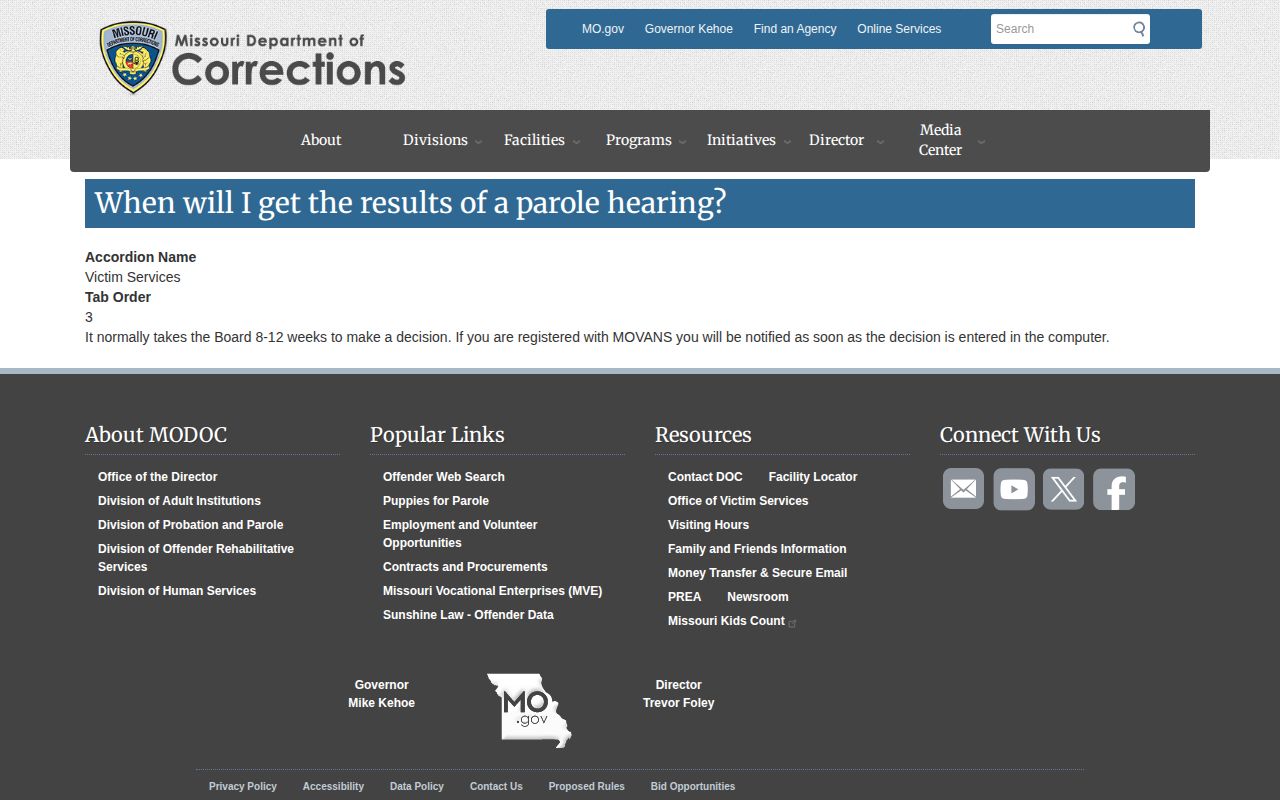
A pending hearing or decision is not yet an actual release, even when minimum eligibility has arrived.
County Jail Release Dates Differ
A local jail may hold a person before trial, on a short county sentence, for another county, or for transfer. Pretrial custody has no sentence expiration to calculate. Bond may be posted, but another hold can still prevent physical release. A court docket may show an order without proving the moment the jail completed processing.
For a sentenced county detainee, ask the holding jail's records unit about its current computation and compare it with the court judgment. Missouri custody credit under section 558.031 is not the same as MODOC good time. Regional boarding adds another step: the physical receiving jail may keep the custody and release record even when the case began in a different county.
A roster is mainly a current-custody tool. Once a person leaves, a local release entry, booking record, or focused Sunshine request may be needed. If the local record says “transfer,” follow the receiving agency instead of treating it as release to the community. Missouri counties do not all operate their own jail, so the case county and the holding facility may differ.
No set pretrial date: A hearing date, bond amount, or expected court action is not a fixed jail release date.
Confirm a Missouri Release Date
For an individual state-prison date, the Parole Board directs questions to the institutional parole office at the facility where the person is confined. Provide the full name, DOC number, and enough sentence detail to avoid a same-name error. Ask which date field is being discussed and whether any Board action, hold, consecutive term, or recalculation remains pending.
For a documentary record, a Sunshine request may seek the sentence-date record, release order, status history, discharge record, or Board decision. Send offender-record requests to OD.SunshineRequest@doc.mo.gov and Board requests to ParoleBoard.SunshineRequest@doc.mo.gov. Ask for electronic delivery, a fee estimate, field definitions, and all open portions.
Chapter 610 requires the records custodian to act as soon as possible and by the end of the third business day. That is the deadline for a response, not a promise that all records will be produced by then. When access is delayed for a reasonable cause, the agency should state the reason and the earliest date the record will be available.
A narrow request is easier to identify. Include the full name, DOC number, cause number, date range, and the exact record sought. Request the current sentence-date calculation or a named release order rather than asking the custodian to answer a broad legal question. If part of the record is closed, ask for the open material that can be separated from it and the legal basis for any denial.
MOVANS can provide a cross-check or notice, but it is not a historical release archive. The Missouri VINELink check explains the current split between local custody notices and MODOC Victim Services.
Release Date Is Not Discharge
Leaving prison may begin parole or conditional release rather than end the sentence. Earned Compliance Credits under section 217.703 apply during eligible supervision, not during prison custody. They are therefore distinct from section 558.041 good time. An eligible compliant person earns credit by full compliant calendar month, while credit does not accrue during absconding.
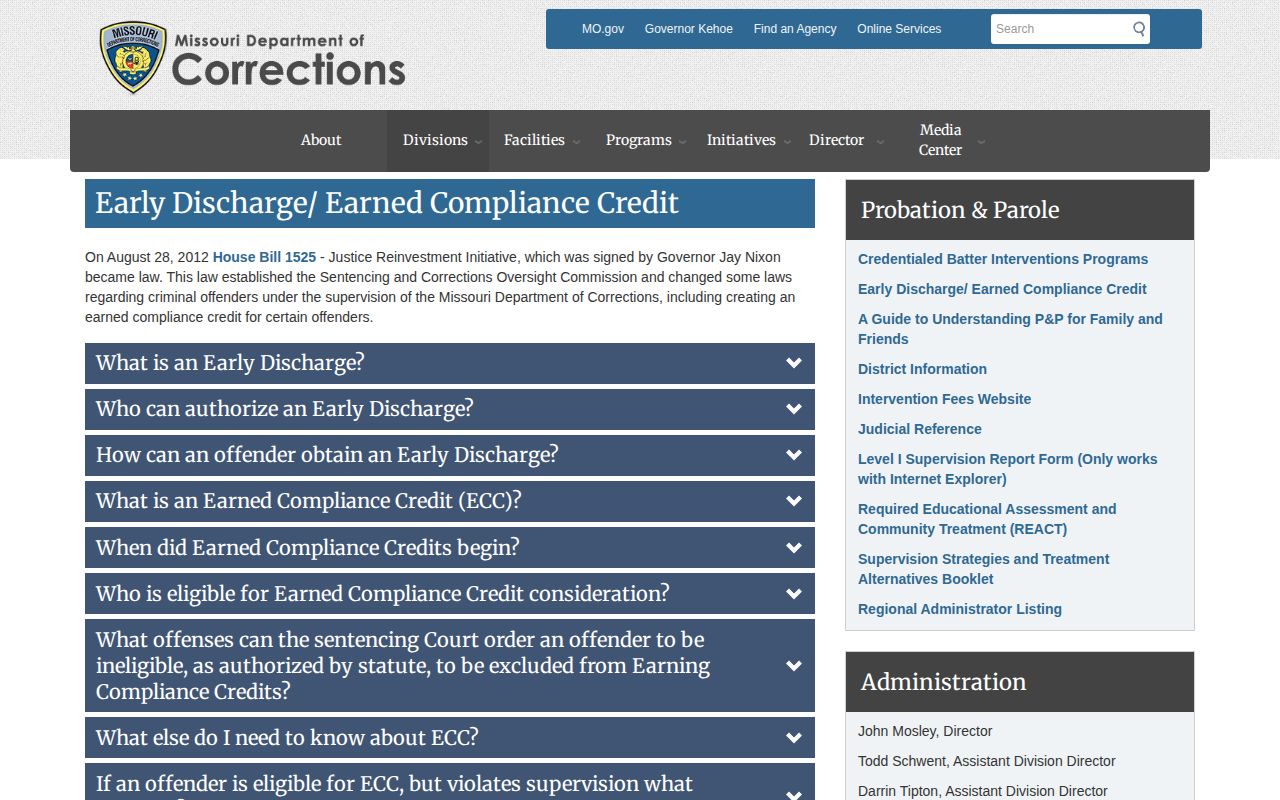
The MODOC early-discharge explanation distinguishes court, Board, and Division authority.
Only the proper final-discharge order ends supervision; a prison exit or projected date does not do so by itself.