
Missouri Parole and Probation
The Missouri Department of Corrections, known as MODOC, uses its Division of Probation and Parole to supervise several groups. They include people placed on probation by a court, people released on parole or conditional release by the Missouri Parole Board, and qualifying Interstate Compact clients. This makes the division the statewide field agency for both words in the page title. It does not make parole and probation the same legal status.
Parole is a discretionary Board release from the remaining prison term. Section 217.690 allows the Board to release a person when it finds a reasonable probability that release can occur without harming the person or the community. Probation is ordered by a court. It can be imposed without a long prison stay, or after a court recalls a person following a 120-day program. Conditional release is yet another form of supervised release. It is a statutory part of many terms of years, subject to exceptions and possible extension for institutional misconduct.
| Status | Who orders it | What it means | Best first check |
|---|---|---|---|
| Parole | Missouri Parole Board | Prison custody ended under Board conditions | MODOC active-offender search |
| Probation | Sentencing court | A court term is served under field supervision | MODOC search, then Case.net |
| Conditional release | Statute and Parole Board | The supervision part of an eligible prison sentence | MODOC search and supervising office |
| Final discharge | Board or court, as applicable | DOC custody and supervision have ended | Nightly historical file or records request |
The Division of Probation and Parole overview shows the statewide scope of field and institutional work. A person on parole is released from prison, but not discharged from the sentence. A person on probation may never have served a standard prison term. Those facts should not be collapsed into a generic claim that someone is simply “free.”
The official Missouri P&P field-office directory shows how the state routes supervision by office.
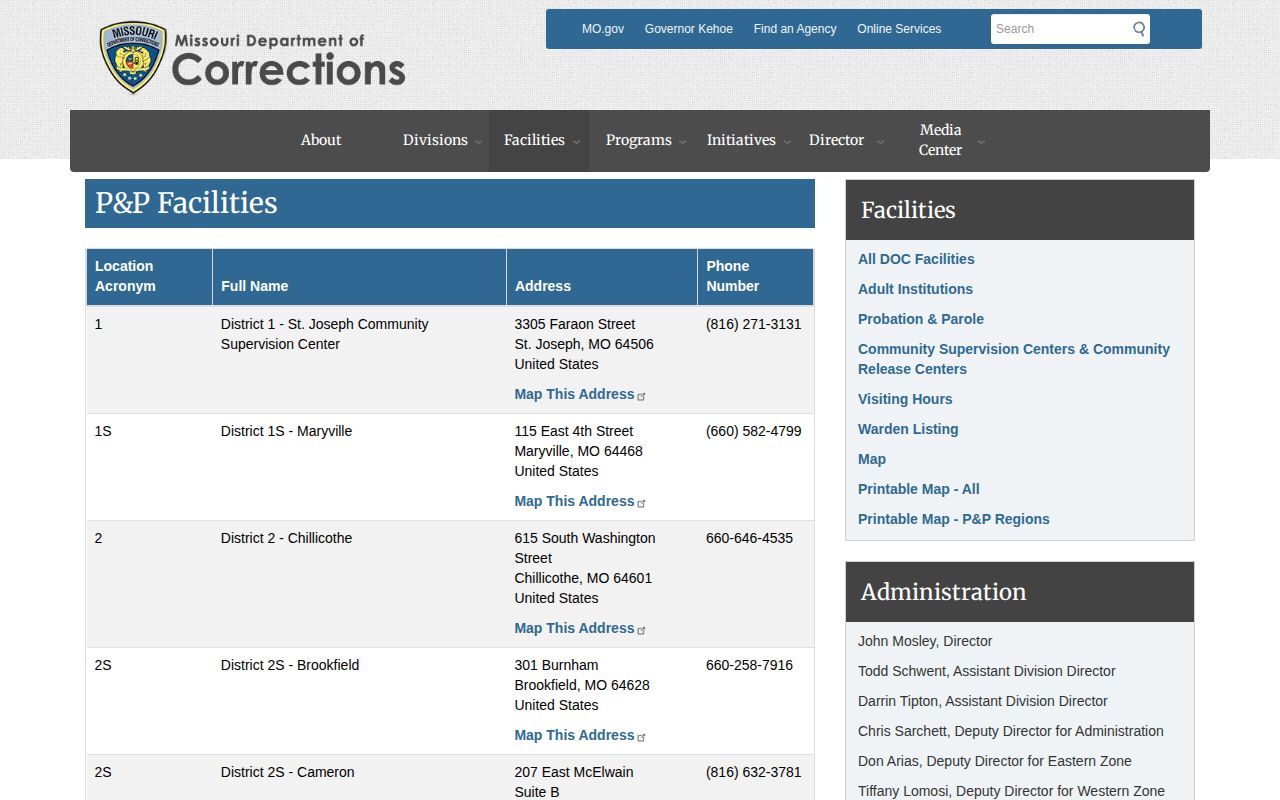
The directory is the office-routing source after an active record confirms the supervision type.
Check Missouri Post-Release Supervision
A sound verification starts with identity, not a same-name assumption. The public MODOC Offender Search includes active probationers and parolees. It also searches aliases when first and last names are used. A DOC master number is stronger because MODOC assigns that unique identifier to the person for life. The search carries a data-current timestamp, so save that date with any notes.
- Confirm that Missouri state supervision is the system in question. A county-jail release, federal release, or immigration-custody change may not create a MODOC record.
- Open the MODOC Offender Search. Use the DOC number when known, or search the full name and documented aliases.
- Compare identifiers, cause number, county, offense, and sentence data. Do not select a record from the name alone.
- Read the assignment carefully. A field assignment indicates community supervision, while an institution assignment points to confinement.
- Use the P&P directory to locate the proper field office. Ask the office a focused question and give the DOC number.
- Compare the court cause number with Missouri Case.net when the difference between court probation and Board parole matters.
MODOC identifies supervision confirmation, supervising officer, office location, term, custody or bond status, parole or conditional-release date, and the Board release decision as open information. A current-status question still belongs with the assigned officer. Search data can lag a case action, and a field office can distinguish an old entry from the status it now administers.
The official offender search screen is the starting point for an active Missouri supervision check.
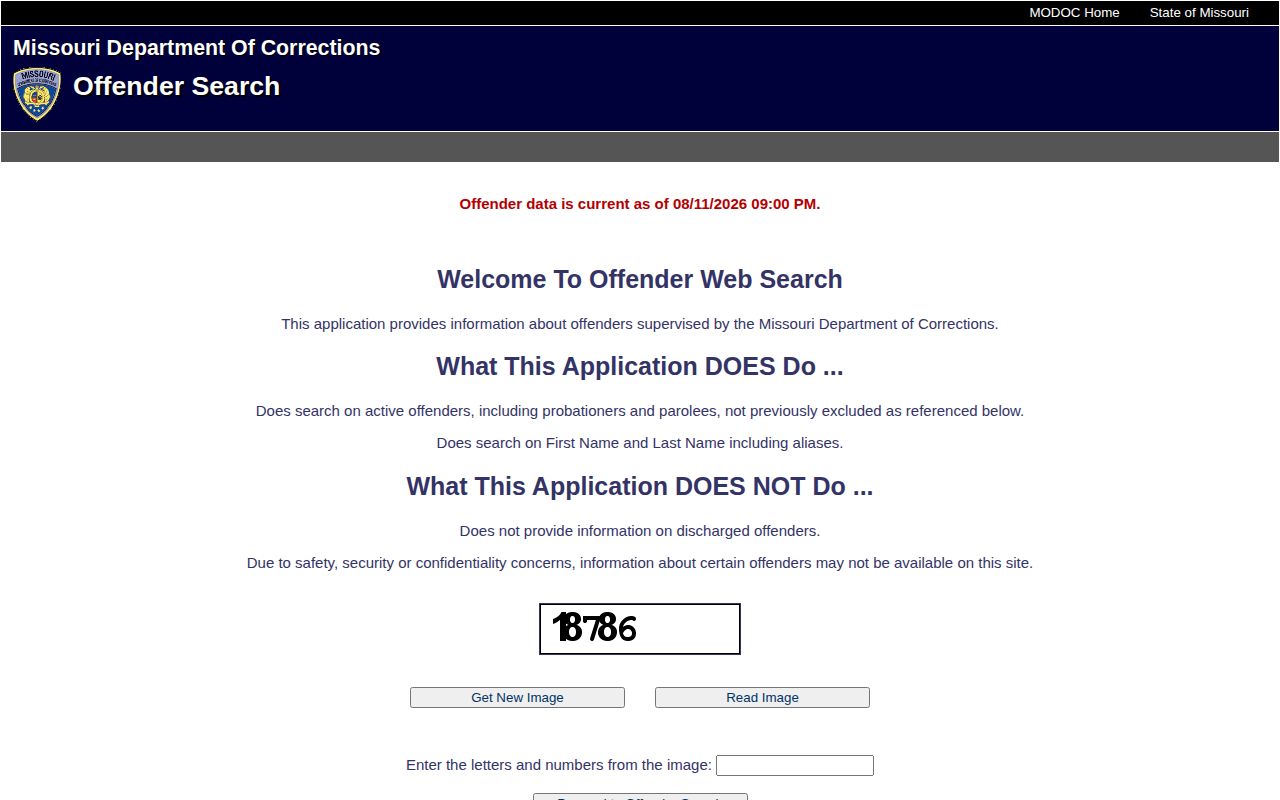
Its active-only scope is crucial because discharged offenders are deliberately excluded from the interactive results.
For the statewide search path after release, including county and federal records, use the Missouri released inmates lookup. That broader route keeps each custody system in its proper lane.
Missouri Supervision Agencies
The Missouri Parole Board decides parole, conditional-release matters, and some final discharges. The Division of Probation and Parole carries out field supervision. Courts retain authority over court probation. An institutional parole officer handles a confined person’s planning and Board process, while a field officer handles an active community case. One statewide address cannot replace the assigned office because Missouri uses a network of field offices, institutional offices, and residential centers.
Statewide supervision contacts
Missouri Department of Corrections
Division of Probation and Parole
Division overview
Field-office directory
Missouri Parole Board
Board information and rules
The MODOC home page places supervision within the full corrections agency.
This agency route is appropriate for Missouri state cases, not for a local jail record or a federal supervised-release question.
Interstate Compact cases add one more distinction. MODOC may supervise a person living in Missouri for another state, or another state may supervise a Missouri case. The active record and assigned office are better guides than the person’s current county alone. Ask which state owns the sentence and which office provides day-to-day supervision.
County boundaries still matter for office routing, but not in the same way they matter for jail records. A jail custodian can confirm when local custody ended. A circuit court can explain its probation order. MODOC can confirm a statewide supervision assignment. When those records seem to conflict, compare their dates and authority instead of choosing one as the universal answer. A person may leave a county jail, report to a MODOC field office, and still have an open court case. Each fact can be accurate at the same time.
Residential centers also belong to the P&P network, but they should not be treated as ordinary state prisons or county jails. Their role can involve structured supervision and transition. The active assignment and direct office response establish what a placement means in a specific case. A public directory entry by itself does not establish confinement, absconder status, or the end of supervision.
Note: Public confirmation does not open the full parole or probation file, which Missouri law treats as privileged subject to limited discretionary access.
Missouri Supervision Status Changes
Conditions are rules attached to community supervision. They can include reporting, approved residence or travel, program participation, and other case-specific terms set by the court or Board. Public information may confirm the term and office, but it does not reveal every document in the case file. The officer is the right source for a precise current-status question when disclosure is permitted.
A violation allegation does not itself prove revocation. The responsible authority must act through the applicable process. Likewise, an absconder is a person alleged to have stopped reporting or left supervision, not merely someone whose online address is old. MODOC operates a round-the-clock Command Center for electronic-monitoring and community-center cases and coordinates apprehension work, but the research found no public statewide absconder-name list. LENS is restricted to criminal-justice users and is not a public search route.
- Parole
- Board-authorized release from prison under conditions before final discharge.
- Probation
- A court-ordered term served under community supervision.
- Absconder
- A person alleged to have stopped complying with required supervision contact.
- Revocation
- An official action that can return a person to custody after the required process.
- Discharge
- The legal end of the applicable custody or supervision term.
MOVANS can provide notifications for covered events, but it is not a public absconder database. Since the 2026 change, local-jail and court registration routes differ from MODOC custody notification. A supervision question should still be confirmed with MODOC rather than inferred from an alert or lack of one.
Missouri Early Discharge Credits
Missouri’s Earned Compliance Credits apply to supervision, not prison good time. Under section 217.703, an eligible person earns 30 days of credit for each full calendar month of compliance. Credits do not accrue during absconding. The Division calculates the remaining supervision time at least twice each year and provides notice when an impending discharge is near.
Authority depends on the case. A court may control probation discharge. The Board controls parole or conditional-release discharge. The Division calculates qualifying compliance credits. A person must satisfy the custody, supervision, and credit requirements, and the statute sets a minimum period before final discharge through this route. Credits therefore shorten the supervision calculation when the law allows; they do not rewrite the original prison release date.
The official MODOC early-discharge page separates the court, Board, and compliance-credit paths.
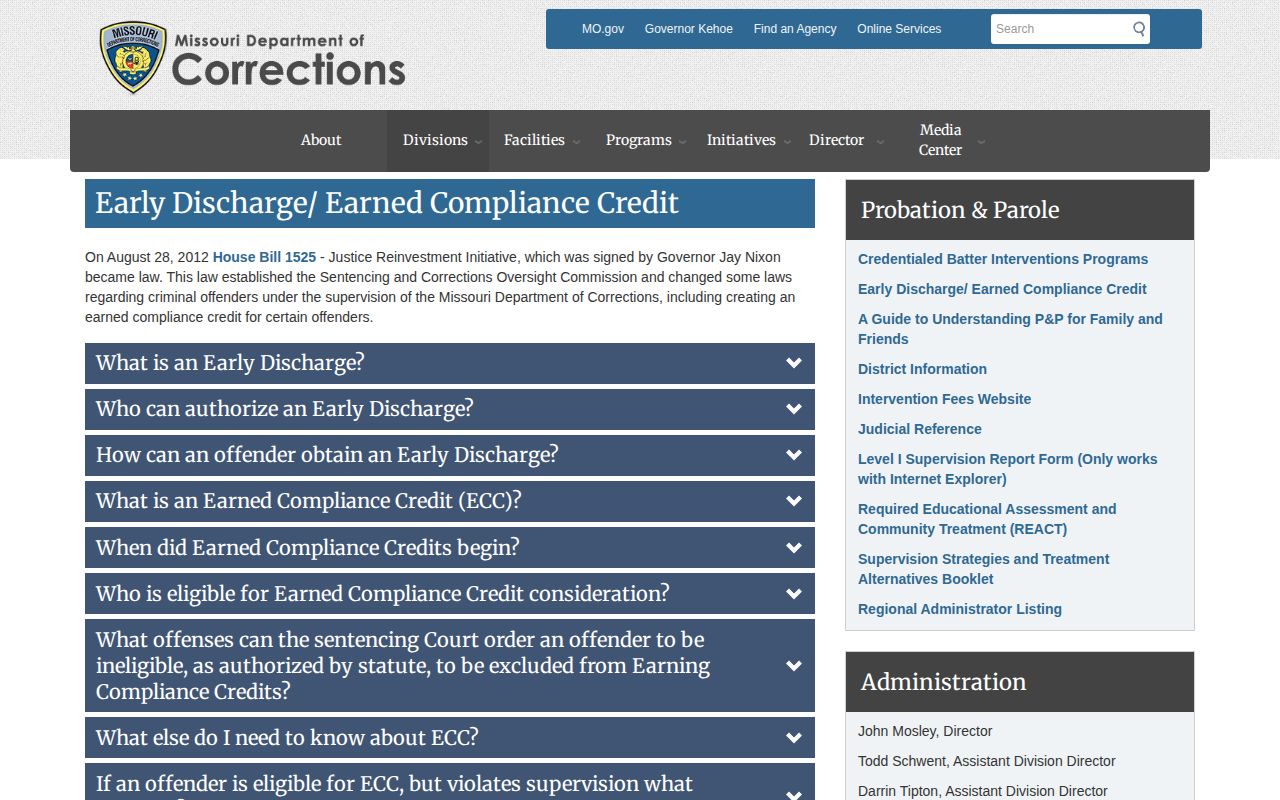
That split helps identify who can answer a question about the end of a particular Missouri supervision term.
Does an estimated discharge date end supervision automatically? No. Treat it as a calculation to confirm with the assigned office. Credits may stop, a court or Board action may intervene, and the final order matters more than an old estimate.
Missouri Certificate of Discharge
Final discharge has its own Missouri record. Section 217.730 permits the Parole Board to order final discharge when it finds discharge compatible with the welfare of both society and the person. The Board then issues a certificate of discharge. Ordinarily, the order cannot occur less than three years after parole or conditional release unless the sentence expires sooner. Written information about the voter-registration process must be supplied after discharge.
This certificate marks a different event from walking out of prison. A person outside prison can remain an active MODOC result during parole or conditional release. Once finally discharged, the interactive offender search no longer supplies that person because the search expressly excludes discharged offenders. The nightly Sunshine Law offender file then becomes the official self-service history route.
The MODOC Sunshine Law page explains the historical file and the separate records custodians. Its file covers people who are or have been supervised as far back as the documented data permits. It is charge-level, so all rows tied to the DOC number must be read together. A completed flag on one sentence does not prove that every other sentence is complete.
For a copy of a discharge order or certificate, send a focused request to the proper MODOC custodian. Include the full name, DOC number, date range, and cause number when known. Ask for electronic delivery, code definitions, an estimate, and all segregable portions. Medical and treatment material remains confidential without the required authorization.
Missouri’s nightly file can help frame that request. An F location-function flag means field, while I means institution. A sentence-completed flag of Y applies to that charge row, not automatically to every sentence associated with the DOC number. Minimum and maximum release dates also retain their distinct labels. Grouping all rows by DOC number reveals whether another sentence may explain why a person remains under MODOC authority after one row shows completion.
Note: Final discharge ends MODOC supervision, but it does not erase the court case or convert a prior release date into a discharge date.