
Missouri Parole Board Authority
The Missouri Parole Board is the statewide body that considers discretionary parole. Section 217.690 gives the Board its general release authority. The core question is whether there is a reasonable probability that release can occur without detriment to the community or the person. Eligibility permits review; it does not compel approval. The Board can impose conditions and may set a later release date when it grants parole.
Board guidelines help organize cases, but they are not guarantees. The Board reserves discretion to set a date below or above a guideline range when law permits. Members review institutional conduct and adjustment, completed or needed programs, the release plan, offense conduct, victim impact, prior history, and other relevant information. A sentence may also carry a statutory minimum that the Board cannot waive.
The official Missouri Parole Board page collects Board rules and sentence-guideline material.
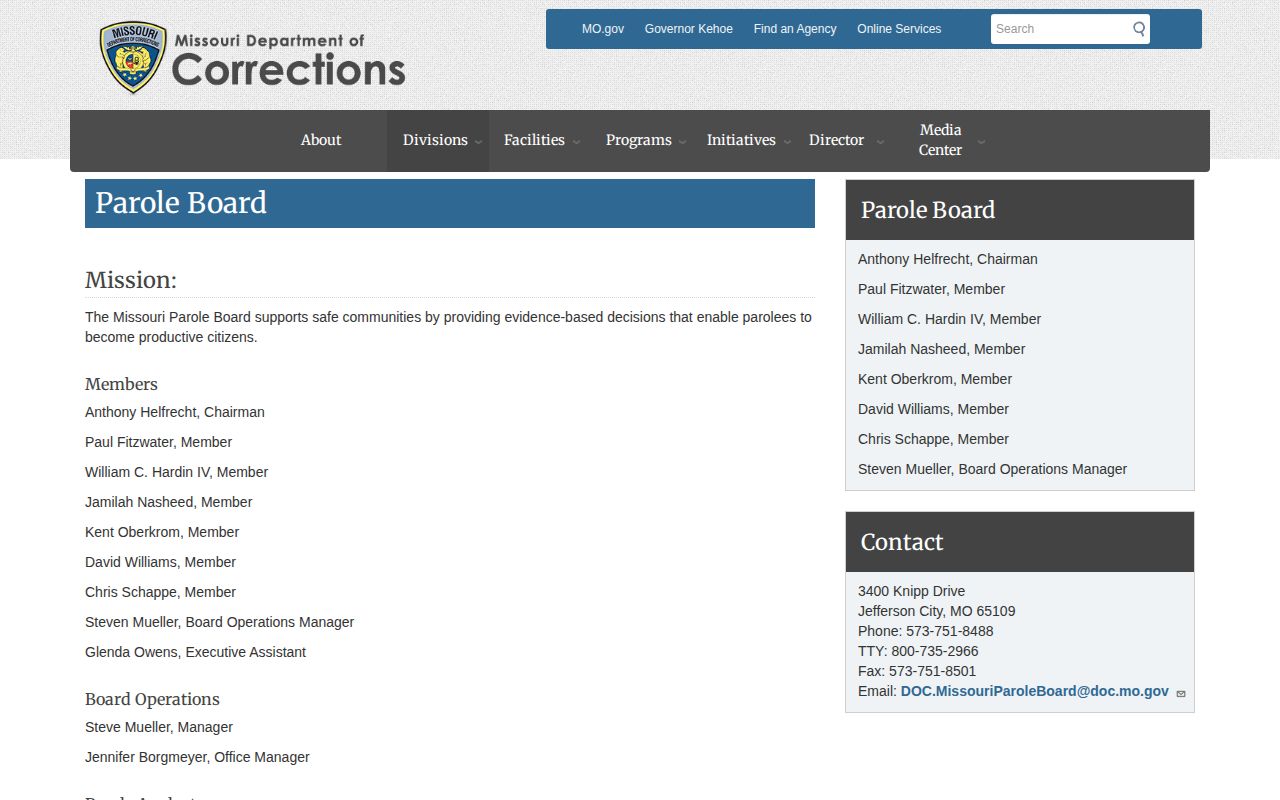
The page establishes the Board as the authoritative source without presenting a named-person hearing list.
- Eligibility
- The legal point when the Board may consider parole.
- Hearing
- The review at which the Board examines the case and release factors.
- Release decision
- The Board action granting a date or continuing the case.
- Physical release
- The later event when prison custody actually ends.
- Final discharge
- The eventual end of MODOC supervision and custody authority.
Locate a Missouri Hearing Date
Missouri does not publish a standalone statewide calendar that can be searched by an inmate’s name, DOC number, facility, or month. The public hearing-process page and the Board’s policy material describe the framework instead. The Blue Book says eligible hearings are generally scheduled within 90 days after reception and held about four months before minimum eligibility, with grid and other exceptions. The public page also says timing depends on sentence length. Exact notice goes to the offender.
- Confirm the person is in MODOC custody. A county-jail case or federal sentence follows a different process.
- Use the MODOC Offender Search to match the person by DOC number, name, aliases, and case details.
- Review sentence data and minimum-service rules. Do not treat a minimum date as a hearing date.
- Read the Missouri parole hearing process for the current framework.
- Ask the institutional parole office at the facility for a person-specific scheduling question. The exact notice held by the offender is more precise than a general timetable.
- Use MOVANS or DOC Victim Services for notification when the registration type covers the case.
The official hearing-process source explains the review and scheduling context.
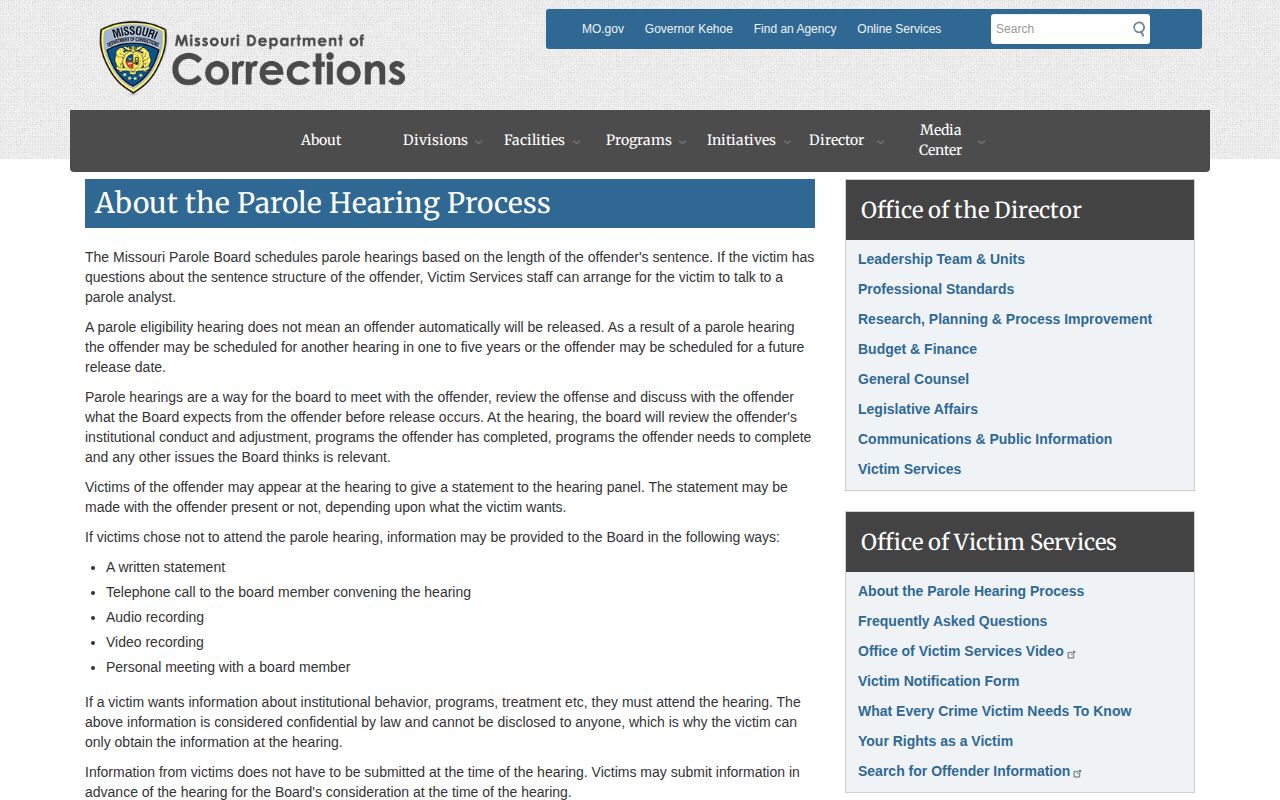
It should be used as policy guidance, not represented as a calendar of upcoming named hearings.
Minimum eligibility, a hearing date, and a planned release date answer three different questions. The nightly offender file labels Sentence-I Minimum Release Date and Sentence Maximum Release Date. Neither label is a substitute for the hearing notice. A court docket can show the sentence and later court action, but it does not prove when the Board met.
Find a Missouri Parole Decision
The Board does not publish a public statewide decisions or results search. Current named-person status travels through active MODOC channels. Documentary and historical results travel through the Board’s records custodian. This split matters because a result may affect a release plan before the person’s public assignment changes.
- Allow for the Board’s stated decision period after the hearing. An immediate result should not be assumed.
- Check the active MODOC record for assignment and parole or conditional-release information.
- Use MOVANS or DOC Victim Services if a valid notification registration covers the person. Registered MOVANS users are notified when a decision enters the system.
- Contact the institutional parole office for a specific current-status question concerning a confined person.
- For the actual decision document or a historical result, write to ParoleBoard.SunshineRequest@doc.mo.gov with the full name, DOC number, cause number, and date range.
- Ask for the decision record, electronic delivery, a fee estimate, code definitions, and all segregable portions.
The MODOC decision-timing notice says a decision ordinarily takes 8 to 12 weeks after the hearing.
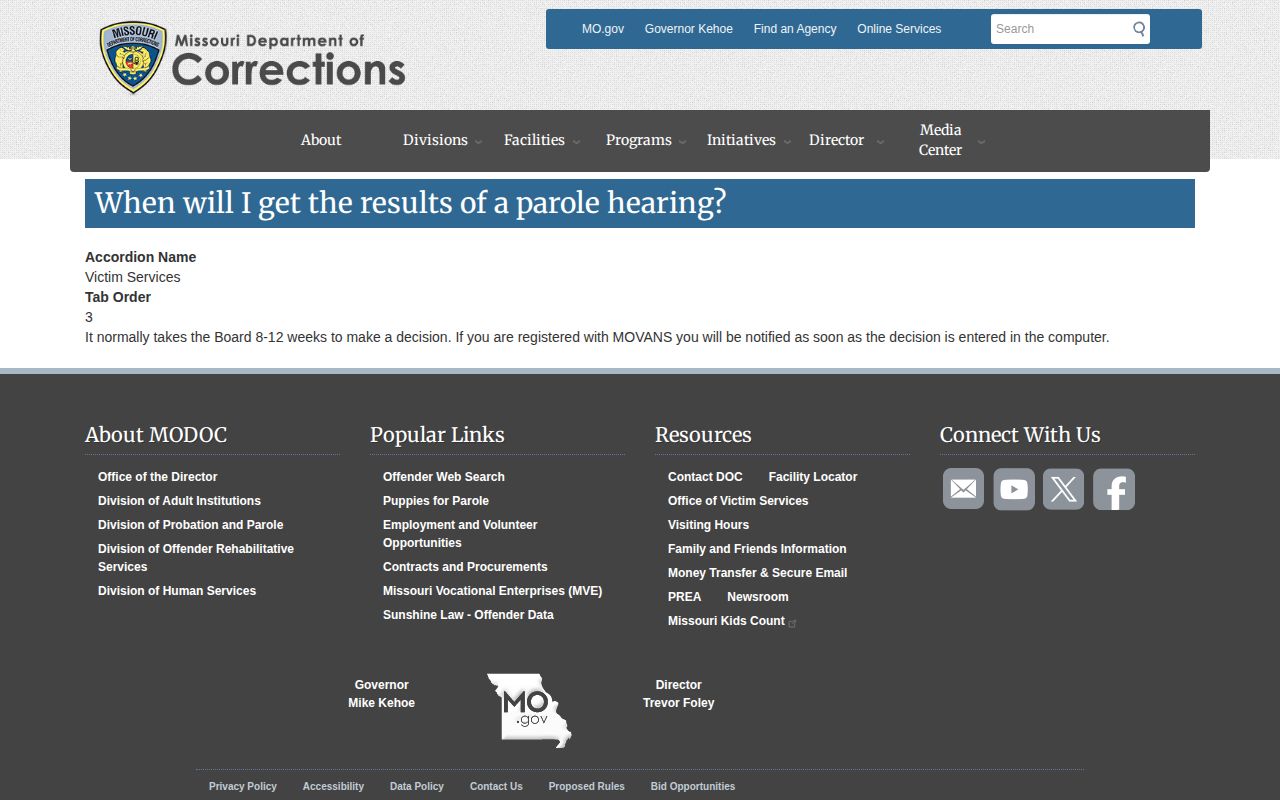
The stated range explains why the absence of an immediate decision is not itself a denial.
A focused Sunshine request is stronger than asking for an entire parole file. Section 549.500 privileges documents prepared or obtained by Board or P&P staff, though inspection can be allowed for the offender, counsel, or another person with a proper interest. Missouri’s open-records law also requires open and exempt material to be separated where possible. Request the existing decision rather than confidential treatment or assessment material.
The MODOC active search excludes discharged offenders. If a long-past Board decision is at issue, the nightly historical file and a custodian request are the proper official routes. The MODOC offender search details explain how to reconcile its active and historical tiers.
Missouri Parole Hearing Outcomes
Missouri’s sources support outcomes more precise than a simple yes or no. A hearing can lead to a future release date or another hearing set one to five years later. A favorable decision still precedes release processing. Institutional conduct, sentence law, detainers, and the release plan can remain important after the vote.
| Outcome | Meaning | What follows |
|---|---|---|
| Future release date | The Board approves release for a later date under stated conditions | Institutional staff complete planning; custody ends only when release occurs |
| Another hearing | The Board does not set release and schedules later review | The next hearing is generally set within the Board’s one-to-five-year range |
| Conditional-release action | The Board applies the statutory supervision component or considers an extension | The sentence and any misconduct process control the date |
| Administrative parole | The Board acts on eligible good-time credit and an institution recommendation | Exclusions and discretionary review still apply |
| Rescission or change | A prior plan is withdrawn or altered through lawful Board action | Confirm the current record with the institutional office or Board custodian |
A release grant does not establish final discharge. Parole normally places the person under Division of Probation and Parole supervision. The conditions and field-office route are covered on the Missouri parole and probation page. A transfer to another prison, jail, BOP, or ICE custody is also not community release.
Note: Copy every official date label exactly because eligibility, hearing, decision, scheduled release, actual release, and discharge dates are not interchangeable.
Missouri Parole Eligibility Rules
Section 217.690 supplies Missouri’s general parole authority, including conditions and treatment of consecutive terms. Yet other statutes can control how much of a sentence must first be served. Section 558.019 requires a person convicted of a dangerous felony to serve 85 percent before parole, conditional release, or another early release, or until age 70 after serving at least 40 percent. Section 556.061 defines which offenses fall within the dangerous-felony term.
Conditional release under section 558.011 is a separate statutory sentence component. For many terms of years, the law divides the sentence between incarceration and conditional release, subject to exclusions. Institutional misconduct can lead to a petition and hearing to extend that date up to the full sentence. Good-time administrative parole under section 558.041 is discretionary and depends on an institution-head recommendation and Board action. Jail credit under section 558.031 is not good time.
Those layers prevent a safe date from being calculated with one rule. First identify the conviction, offense date, classification, term, and whether sentences run at the same time or one after another. Then separate minimum eligibility from maximum expiration. The Board or institutional parole office must confirm its current calculation. A public bulk-file date is a snapshot, not an irrevocable promise.
Consecutive terms require added care because the Board’s authority and the governing statutes must be applied across more than one sentence. The first date visible in a data row may concern only one charge. Conditional release on one term also does not cancel a different hold. Review all rows tied to the DOC number and use the court cause numbers to reconcile the sentence structure before asking the institutional office about hearing eligibility.
The same care applies to program references. The Board may consider work completed in prison and work still needed, but a program date is not itself a parole date. Institutional adjustment is one factor among several. The release plan, offense history, victim information, and governing law remain part of the review. Public guidance can explain the factors without predicting how the Board will weigh them in one person’s case.
Does a hearing mean the sentence is parole eligible? The Board schedules within governing law, but the fact of review does not guarantee release. Likewise, an apparent minimum date does not establish that a hearing already occurred.
Missouri Clemency Is Not Parole
Missouri draws a bright line between executive clemency and parole. Article IV, section 7 of the Missouri Constitution gives the governor power to grant reprieves, commutations, and pardons after conviction. The same provision expressly excludes parole from that power. Parole is a Board decision under corrections law, while clemency is an act of the governor.
A clemency application goes to the Parole Board for investigation and a report. That role does not transform the application into a parole hearing. Section 217.800 requires DOC to notify the criminal-record repository when relief is granted. A pardon or commutation may alter legal consequences or the sentence, but it should not be presented as proof of the exact time someone physically left a facility.
The distinction controls record searches. A parole decision request goes to the Board records custodian. Clemency authority rests with the governor, with the Board supporting the application review. MODOC status and court records may reflect later effects, but each source answers a different question. Confirm the underlying order before describing its result.
Missouri Hearing Decision Alerts
Missouri’s notification route changed on May 5, 2026. Local-jail custody and statewide court-event registration still begins through VINELink or MOVANS. MODOC custody registration remains with DOC Office of Victim Services. SMS and email alerts continue, while phone and VINELink app alerts ended. An older page that instructs users to wait for an automated call is no longer current where it conflicts with the transition notice.
The MOVANS registration source explains the registration paths.
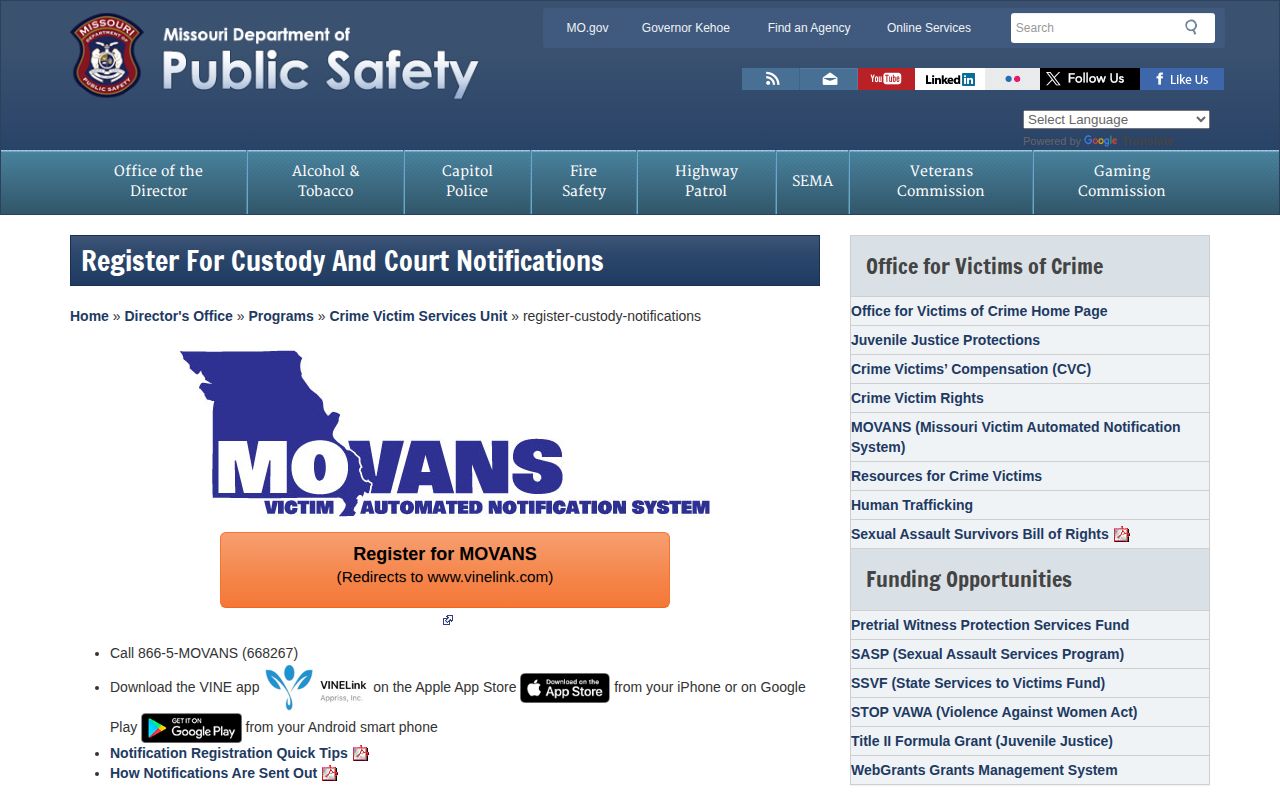
Registration must match the event category because a custody registration does not also create court-event registration.
MOVANS is a notice and cross-check service, not the missing public hearing database. A registrant may receive notice when a Board decision enters the system, but the alert is not the full decision document. For the underlying record, use the Board custodian. For a current MODOC case, use Victim Services or the appropriate institutional office.
When notice and the active record appear out of sequence, preserve both timestamps and seek direct confirmation. The alert may reflect the time an event entered the notification system, while the offender search carries its own data-current time. Neither timestamp should be rewritten as the date the Board voted or the date prison custody ended unless the source labels it that way.
Note: A missing alert can reflect registration scope, data timing, or system coverage, so confirm the event with the agency that created it.